
We would like to thank Alisa Feldman, PhD., Director of Research at the ADL for assisting with the production and review of this report.
Jewish enrollment at Harvard has been cut roughly in half — from the teens to about 7 percent — over the past decade. At Brown and Cornell, it held steady near 20–24 percent.
The decline is not universal. It is specific to Harvard and, to a lesser degree, Yale.
This report asks why. It tracks Jewish enrollment across nine universities from 1967 to 2025, tests seven structural explanations against cross-institutional data, and identifies the policy choices most likely to have driven the divergence. It does not establish intent or causation — it establishes a pattern that warrants institutional review.
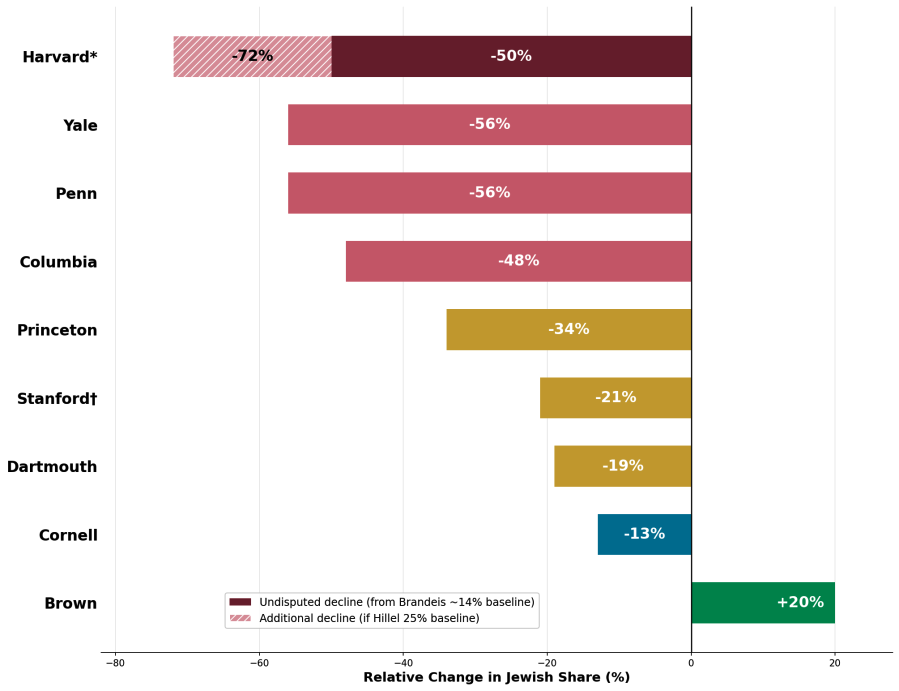
Relative Change in Jewish Enrollment Share, Ivies + Stanford (2013–2025)
Sources: Hillel International College Guide (2013–2025, via Wayback Machine); Brandeis CMJS/SSRI 2016 survey (~14% Harvard baseline). *Harvard: solid = undisputed decline from Brandeis ~14% baseline (−50%); hashed = additional if Hillel 25% baseline (−72%). †Stanford baseline is 2014.
What We’re Asking
This report makes three requests of Harvard. None require changes to admissions. All three ask Harvard to do what it already does for every other demographic group it tracks.
- COUNT. Track Jewish enrollment — applicants, admits, enrolled students — using the same voluntary self-identification Harvard applies to race, gender, and geography. Publish the results annually. Harvard collected this data through the early 1990s and stopped. That gap is why this report had to be written by alumni.
- AUDIT. Review whether admissions policy changes over the past two decades produced disproportionate effects on Jewish applicants. Harvard has the internal records to answer this question. We are asking them to look.
- CORRECT. If the audit reveals disproportionate impact, fix what caused it — not through quotas or targets, but by removing the blind spot that allowed a 50 percent decline to go undetected for a decade.
CONTACT US
This report is a living document. We welcome corrections, better data, and constructive feedback from alumni, institutions, researchers, and journalists.
Press & media inquiries: Adrian Ashkenazy, President
Contributions, corrections, or comments: info@harvardjewishalumni.org